Development Update April 2026
The forward overhead is complete, 133 annunciators light up, and the electrical schematic gets wired in.

It's been a busy two months at Airfoillabs and we're glad to be back with another behind-the-scenes look at where the AFL 737 MAX is heading. The flight deck is really starting to come alive - switches click, guards flip, annunciators light up, and the systems behind them are getting wired in piece by piece. Let's dig in.

Airfoillabs Team
Forward Overhead Panel: Switches Complete
The forward overhead is now fully built out. Every switch, selector, guard, and rotary on the panel is in place with correct cold-and-dark defaults, animation timing, spring-loaded return behavior, and guard logic that matches real flight deck feel.
That covers the full electrical panel (battery, generators, drive disconnects, standby power, bus transfer), the engine start panel, all six fuel boost pumps with crossfeed, hydraulic pumps for systems A and B, the complete bleed air and air conditioning section (engine bleeds, APU bleed, isolation valve, trim air, recirc fans, packs, zone temps and the 7-position air temp source), pressurization with mode selector and digital readouts, anti-ice, window heat, probe heat, passenger signs, exit lights, CVR, wipers, and the flight controls block including alternate flaps, yaw damper and spoiler A/B.
If you've spent time in the real flight deck, this should feel familiar the moment you sit down.
Overhead Animations and Manipulators
Annunciator System: 133+ New Indicators
We rolled out a comprehensive annunciator system across five flight deck panel locations, with 133 new warning and status lights:
Forward Overhead - 98 indicators (hydraulic pressure, fuel filter bypass, battery discharge, generator status, equipment cooling, doors, window/probe heat, anti-ice, bleed air, and more)
Left Forward Panel - 9 (below G/S, takeoff config, cabin altitude, AP/AT/FMC, speed brake, stab out of trim)
Right Forward Panel - 9 (speedbrakes extended, GPWS INOP, runway awareness INOP)
Center Forward Panel - 6 (nose/left/right gear transit and down-locked)
Aft Electronic Panel - 11 (fire detection, APU det, cargo, wheel well fire)
Each light has full state management, light-test mode, unpowered logic, and a smoothing pass on the output to keep things from flickering. The annunciator framework is generic enough that hooking new lights into system state is now a quick job rather than a custom build each time.
Electrical System Schematic: Logic Wiring in Progress
We've designed and animated a full Electrical System schematic that we are now connecting to the underlying electrical logic, the overhead panel switches, and the cockpit displays. This is the kind of plumbing work that doesn't always show up in screenshots, but it's the foundation that lets generators, buses, transfers, and failures behave correctly across the rest of the aircraft. There's a short demo of the schematic in the video below.

Electrical Scheme Demo
FMS / LNAV: Continuing the Build
LNAV got a major refactor and a series of meaningful upgrades:
Fly-over transition geometry - improved path following through fly-over waypoints
Wind-corrected heading legs - heading leg geometry now factors in wind
Terminal procedure turn direction - published turn direction constraints are respected
Predicted speed in transition turns - leg transition arcs are now built from predicted speed instead of current, which makes turns much more accurate when accelerating or decelerating
LateralLocation refactor - cleaner internal data model under the hood
Progress page - work-in-progress CDU progress page is taking shape
A lot of this is invisible until you fly a tight terminal procedure in wind - and then it suddenly matters a lot.
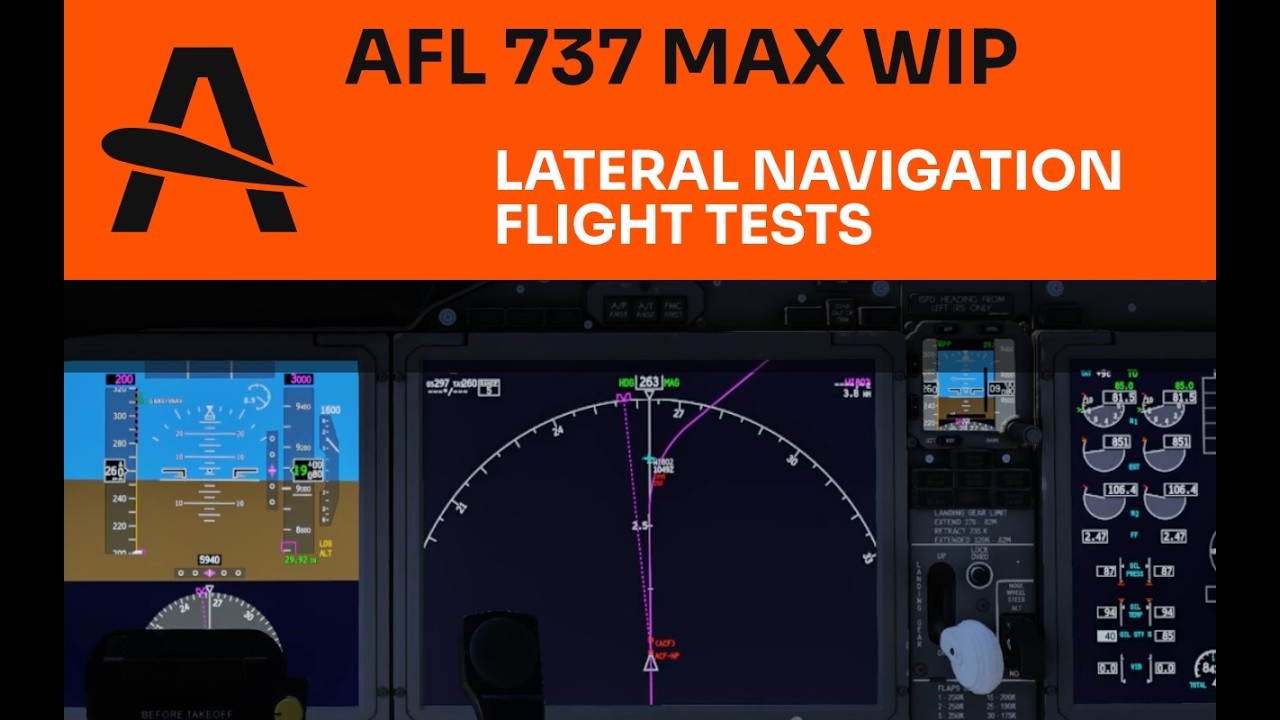
Lateral Navigation Flight Tests
Landing Gear Physics, Nacelle Vibration & Gauge Animation
Landing Gear Physics
We replaced the old interpolation-based strut compression with a real physical model using actual strut travel constants (0.44 m main gear, 0.29 m nose gear), and built a small testing framework with custom datarefs that lets us inject artificial downforce for animation tuning. The nose gear now exposes deploy ratio, piston compression, tire rotation, and steering as datarefs.
Nacelle Vibration
On top of that, we added a multi-layer nacelle vibration system with three independent sources per engine - ground bumps, thrust-aero coupling, and turbulence - driven by 12 independent vibration generators per engine with randomized phase offsets. The result is realistic, asymmetric engine motion you can feel in the cockpit, with real-time tunable gain datarefs for fine-tuning.
Gauge Animation: Spring-Damper Physics
Replaced the old gauge animation with a pure Lua spring-damper simulation (needleFx()), modeled as a damped harmonic oscillator. It's frame-rate independent with sub-stepping, has a configurable damping ratio from underdamped through critically damped to overdamped, and uses a settling threshold to stop computation cleanly. Needles now move the way they should - quick, but with that subtle real-instrument settle.
Autopilot Test Mode & XJet Framework
Autopilot Test Mode
To unblock FMS work without waiting on the full autopilot integration, we built a standalone autopilot test controller: PI bank angle control, a cascade VS controller (outer integrator plus inner PD pitch loop), and custom datarefs for commanding bank and vertical speed. This lets us iterate on FMS guidance independently and is already paying off.
XJet Framework & Infrastructure
Plenty of platform work too:
vecmath to JOML migration completed across the rendering pipeline
New font rendering system with MCDU TrueType fonts
CEF (Chromium Embedded Framework) integration for in-cockpit browser-based displays - this is what powers the upcoming HTML-based EFB and system pages
Tablet/EFB integration on the cockpit side
Library updates across avionics, UI, graphics, console and subsystem modules
General performance cleanup and excess logging removed

EFB Proof of Concept
What's Next
Functional Electrical System with integrated EFB HTML windows showing live electrical state
CDU Progress page completion
Full autopilot integration (currently in test mode)
Continued LNAV/VNAV refinement
Wiring annunciators to actual system state across the aircraft
EFB tablet app buildout
As always, thank you all for the patience, the encouragement, and the sharp eyes in the comments - it genuinely keeps us going. We'll be back with more soon.
Clear skies,
Juraj, Airfoillabs
Join the discussion of this update on the X-Plane.org forum.
AFL 737 MAX is an independently developed add-on for X-Plane, not affiliated with or endorsed by any aircraft manufacturer. Full disclaimer


